

Which outlining method is for you?
Every storytelling problem has a solution. You just need to find the shoe that fits.


When I first came to writing fiction from years in journalism and book editing, I had a vague idea of the three-act story structure and knew that writers liked to settle into one of two camps: plotters (outliners, also called architects) and pantsers (organic writers, also referred to as gardeners).
I studied the Plotter/Pantser grid (below) and realized I may be the “Chaotic Plotter” type.
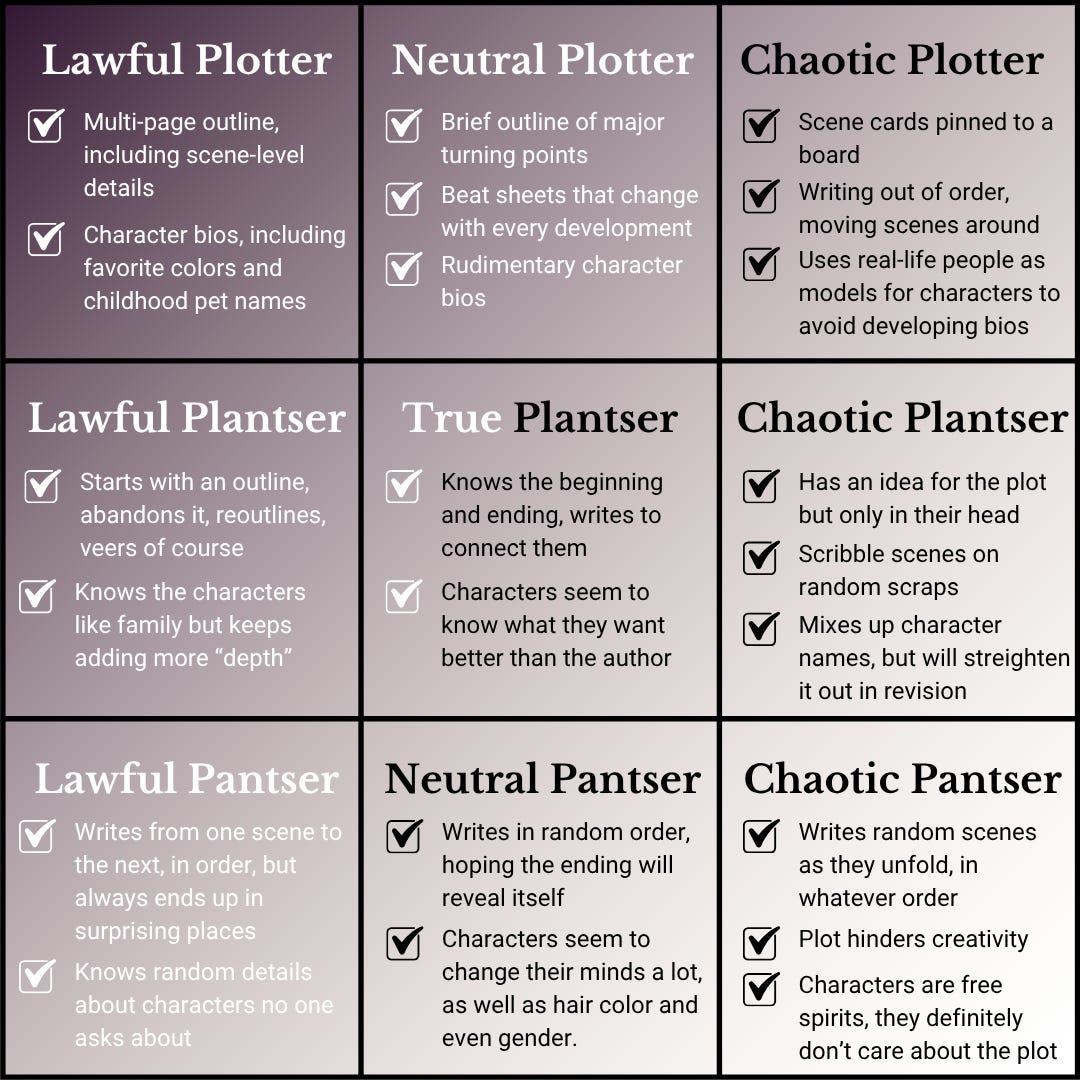
As I progressed from one project to the next (some never getting finished), I realized I liked to know where my story was going, but at the same time, a rigid outline never seemed to fit for more than a few scenes. Then my story would organically diverge from it—like a new reality thread in a multiverse—where the current draft and all the previous, rejected versions could somehow coexist and even inform one another.
I started studying craft books and consuming courses, adding more theories and tools to my writing tool belt. Eventually, I saw how many techniques overlapped and ultimately boiled down to the same old three-act story structure.
Problem dictates the solution
The real lesson I learned in the end is not what story structure is, but how to approach it when I’m hitting a wall. And with each project, the wall can be different. I might get stuck in the weeds of scene-level events without an overarching goal. I might struggle to give my characters proper depth. My character might be moving further away from the lesson they’re supposed to learn, or the lesson they learn doesn’t feel complete.
These are some of the most common problems fiction writers face, and the reason there are so many outlining techniques is that each is trying to tackle one of these issues.
There is no one-size-fits-all outlining technique, just as no two writers are the same.
We are naturally drawn to one side of the spectrum—plotter or pantser—but also with a tinge of lawfulness or chaos in the process.
How to find my outlining method?
I have a shelf full of craft books on storytelling: Save the Cat! Writes a Novel, The Story Grid, Story Genius, The Hero with a Thousand Faces, The Heroine’s Journey, The Character Arc, and many others. Below, I map out the outlining methodologies I’ve learned from them and pair them with the problems they’re best suited to solve. Then, I dive deeper into each one.
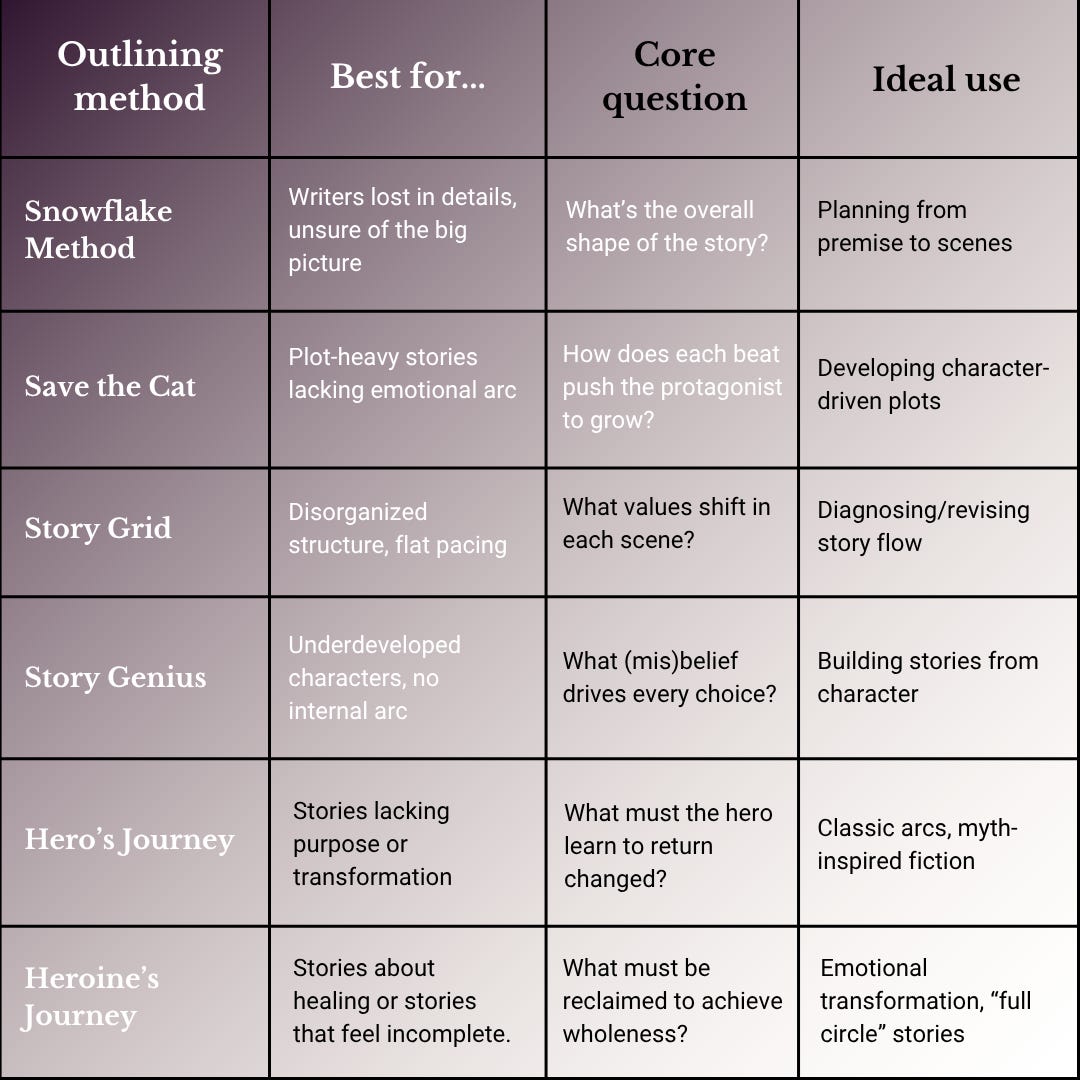
Which outlining method is right for you?
Struggling to plot your novel? Maybe you have a stubborn character who refuses to change no matter what trials you put them through. Perhaps your character moves from scene to scene in a random fashion, and you can’t seem to push them in the right direction. The right outlining method can help, regardless of whether you are a planner or a pantser (there’s a pantser-centric method at the end)—but it depends on what isn’t working.
Below is a quick guide to help you diagnose your story’s symptoms and match them to the framework that fits.
Lost in the weeds?
If you craft rich settings and layered characters, but your story refuses to unfold—or you feel buried in details and can’t see the big picture—zoom out. Try Snowflake and take it from the top: premise to three disasters and an ending.

Snowflake is a top-down planning tool that starts with the simplest possible version of your story—a single sentence—and gradually expands it into a full outline.
You build your story like a fractal (from the general shape to more and more detail):
One-sentence summary (your hook or premise)
One-paragraph synopsis (major turns: beginning, three disasters, and ending)
Character summaries (motivation, goals, conflicts)
Expanded synopsis/narrative outline (one paragraph per scene or chapter)
The brilliance of Snowflake is how it helps you see structure before diving into scenes. Or pulls you out of the minutiae and shows you the big picture. If you struggle with messy middles or get distracted by line edits while drafting, Snowflake gives you clarity and forward motion.
Other tools that help you stay “zoomed out”:
The Pixar Story Spine, a cause-and-effect chain that distills narrative flow, focusing on the cause and effect of each plot point:
“Once upon a time… Every day… Until one day… Because of that… Until finally…”The elevator pitch/logline: distill the most compelling elements and the hardest choices your protagonist must make. If you can’t capture it in one sentence, your core premise may be fuzzy.
More on big-picture outlining coming soon.
The protagonist refuses to grow?
If a lot happens in your book but your character seems to meander through it, reacting rather than acting, with no discernible growth even 60% in—you might have a plot without an arc of change. Try Save the Cat to figure out characters’ reactions to events and make sure they have opportunities to grow.

Save the Cat is a beat-based framework that ensures your character’s arc drives the story—not the other way around.
At its core, it’s about cause and effect: action and reaction. Each beat builds emotional momentum through clear decisions.
The key question it forces is: How does this event change my character?
Some of the key beats include:
Catalyst: What breaks their normal world?
Debate: Why are they afraid to act?
Midpoint: What shifts their perspective in the middle of the story?
All Is Lost: What has to happen so that things could not possibly get any worse?
Dark Night of the Soul: What must they finally confront?
Finale: Once they embrace the change within, how will they tackle the greatest challenge of all?
This method also works well for revisions. Diagnose a passive protagonist by mapping scenes to the beat sheet and asking:
Do they make conscious decisions?
Do those decisions come with consequences?
Are they learning anything—or just surviving?
Tip: If you’re writing a transformation arc, try labeling each beat with your protagonist’s internal belief at that moment. You’ll spot missed growth opportunities immediately.
More on Save the Cat for character growth coming soon.
Disorganized scenes and missing beats?
If your character stumbles from A to B to Z with no clear structure, emotional beats feel out of tune or out of order, or the middle sags with little sense of rising tension—try Story Grid to put it all in order. Look at the list of obligatory scenes of your genre and see whether yours has the right ones—and what’s missing.

Story Grid, created by editor Shawn Coyne, is a structure-first approach that helps you build (or fix) your story using genre conventions, obligatory scenes, and unit-level analysis.
At its heart, Story Grid asks:
What type of story are you telling? (Global genre)
What must happen in that kind of story for it to feel complete? (Conventions + obligatory scenes)
What changes from scene to scene—and how? (Value shift)
Start with your genre. Each genre has specific expectations: a love story needs a “meet cute,” a revenge story needs an inciting wrong, a thriller needs a ticking clock. Use the obligatory scenes checklist to find what’s missing.
Then zoom in to the scene level. For each scene, ask:
What value shifts (e.g., from safety to danger, hope to despair)?
Is there a clear turning point?
Does the protagonist make a decision, or does something simply happen to them?
This method is particularly helpful when:
Your story has too many disconnected events
You’re revising and can’t tell what to cut or rework
You want to master cause-and-effect tension and pacing
Tip: Try color-coding your scenes by value shift (+/–). You’ll get a visual map of your story’s emotional rhythm—and you’ll see where flat or repetitive beats need work.
More on using Story Grid to bring structure to chaos coming soon.
Underdeveloped protagonist?
If your main character feels underdeveloped, vague, or reactive—like a blank slate being pushed around by the plot—you may be starting in the wrong place, or have a character-story mismatch on your hands. Consider diving deep into their psyche and backstory with Story Genius. Then come back with a character who will shape the plot, rather than trying to fit within its constraints.

Story Genius (Lisa Cron) flips the traditional “plot-first” approach. Instead of asking What happens?, it starts by asking: Why does it matter to this character?
Readers don’t follow plot points; they follow the meaning a character makes of them.
Begin with your protagonist’s internal misbelief—a deeply ingrained, emotionally charged idea they’ve formed about themselves or the world, usually rooted in a formative backstory wound.
From that, build:
A third rail: the internal conflict that powers every decision
A what-if premise: external events that will test that misbelief
A scene-by-scene progression: moments that challenge the misbelief and force growth
This is especially useful for:
Upmarket/literary fiction, with a strong emphasis on character depth and emotional impact
Character-driven stories in general
Writers who know why they want to tell a story but don’t yet know how to structure it (in other words, the have a clear theme/life lesson in mind)
Guiding questions:
What false belief is your character unconsciously trying to protect?
What events in their past wired them to think this way?
How will the story slowly unravel that belief until they’re forced to let it go?
Before outlining a single plot event, write your character’s origin scene—the childhood moment that planted the misbelief. It becomes your North Star for emotional logic.
More on using Story Genius to build character-driven arcs coming soon.
Story headed in the wrong direction?
If your plot lacks shape, your protagonist refuses to move toward resolution no matter how hard you nudge them, or the story wanders rather than builds—step back and examine the emotional arc. Try the Hero’s Journey to make sure your protagonist learns their lesson and returns with the right “elixir.”

The Hero’s Journey (Joseph Campbell; adapted for writers by Christopher Vogler) maps a protagonist’s emotional and external transformation across twelve stages, from the ordinary world to the return with the solution to the original problem.
It’s especially helpful when your story has:
A clear character transformation at its core
A protagonist who resists the call to change
A journey that leads to self-knowledge or sacrifice
Foundational stages include:
Call to Adventure: Something disrupts the protagonist’s world.
Refusal of the Call: They hesitate or deny the challenge.
Crossing the Threshold: A point of no return; they commit.
Tests, Allies, and Enemies: The journey shapes them.
The Ordeal: A crisis that breaks or redefines them.
The Return: They come home transformed—with knowledge, power, or peace.
The emotional core: the hero learns something they could never learn at home. They leave the familiar, suffer, grow, and return changed—bringing healing or insight back to their world.
This method shines for fantasy and speculative fiction, adventure or epic journeys, and any story that echoes myth, fable, or spiritual growth. Your protagonist doesn’t have to literally “return home.” The “elixir” may be internal: peace, perspective, forgiveness, purpose. Ask: What did they truly gain—and could they have gained it without the journey?
More on using the Hero’s Journey to bring meaning and momentum coming soon.
Craving deeper transformation? Explore the Heroine’s Journey
If your story is about internal change, relational healing, or reclaiming a silenced voice; if your protagonist isn’t just fighting the world but fighting to return to themselves, you may be writing a different kind of journey.
Look into the Heroine’s Journey for a deeper internal change. Sometimes you need both the yin and the yang of internal transformation to bring the story to a successful conclusion.

The Heroine’s Journey (Maureen Murdock) charts a return to wholeness not through conquest or achievement, but through integration.
While the Hero’s Journey often focuses on leaving the known world to gain power, the Heroine’s Journey asks: What has been lost, denied, or broken within—and what must be reclaimed?
Stages often include:
Separation from the Feminine: Rejecting traditional roles or parts of oneself to succeed in a masculine-coded world
Identification with the Masculine: Seeking power, control, or validation through external means
Spiritual Aridity: Success without fulfillment; a growing sense of loss
Descent to the Goddess: A breakdown, inner crisis, or reckoning
Reclaiming the Feminine: Embracing intuition, emotion, connection
Integration: Merging both sides of the self into a whole
This isn’t about gender. Any character can follow a Heroine’s Journey if the story centers on internal reconciliation, relational dynamics and identity, or healing from disconnection, shame, or suppression.
This method is ideal for emotionally rich, character-driven fiction; stories about trauma, silence, healing, or cyclical history; and protagonists who need to reclaim, not conquer. If your character feels directionless or broken halfway through the book, ask: What part of themselves have they abandoned in order to survive? The turning point may not be an external victory but an internal reckoning.
More on structuring stories of emotional healing coming soon.
Prefer to discover the story as you go?
If you feel boxed in by rigid structure and prefer to write “into the dark” guided only by your flashlight—but the story starts to drift or stall around the middle—you’re not alone. Pantsers need structure too, even if a gentler one.

The Scene Card Method doesn’t require a beat sheet, a diagram, or act breaks. All it asks is a few guiding questions, after every scene you draft (or during revision):
Is there a disruption in the scene?
Does your protagonist come into the scene expecting one thing and instead gets something else?
What are the emotions explored in the scene?
To land, every scene needs to dig into emotions. Not just surface level, but deeper ones too. That is how the character grows.
The most important question of all: What changed in this scene?
Is your protagonist better off or worse off than before? Are they more vulnerable than before?
Write each scene on an index card or sticky note and answer that question. You’re looking for movement: of stakes, relationships, or the character’s emotional state.
Over time, ask:
Are the stakes escalating? (disruptions put more and more at risk)
Is there a general direction? (or are you reversing course, and if so, is it intentional?)
Once you have a dozen or more cards, lay them out and color-code them:
Positive change (+)
Negative change (–)
Neutral/no change (0)
If you see long stretches with no shift—or flip-flopping with no buildup—it may be time to revise for momentum or purpose. This method gives you freedom to explore while still tracking cause and effect—the heartbeat of the story. It’s perfect for discovery writers who resist pre-planning, writers in the messy middle, and short-story writers or novelists revising by feel.
More on using scene cards to structure intuitively—without killing your flow—coming soon.
Not just three acts: Other structures exist
Many outlining methods sit atop the classic Western three-act foundation. But other story structures exist and can be illuminating for certain projects.
Have you heard of kishōtenketsu? It emphasizes contrast and twist without relying on direct conflict as the engine of narrative. If your work leans lyrical, meditative, or exploratory, alternate structures like this can help you discover a different kind of momentum.
Do you have a favorite outlining method?
Workshop
Try to diagnose the problem your story is facing and apply the method to fix it. Share your insight!